Publications
Publications are listed in reverse chronological order. Please see Google Scholar for the latest list.
* denotes equal contribution.
2026
- INFOCOM
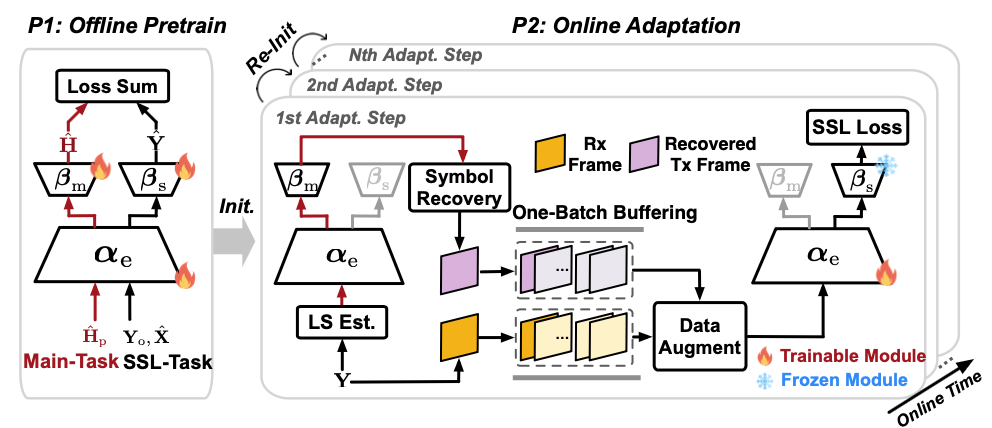 ChannelMAE: Self-Supervised Learning Assisted Online Adaptation of Neural Channel EstimatorsTianxin Wang, Yuanzhe Huang, and Xudong WangIn IEEE Conference on Computer Communications (INFOCOM ’26) , 2026
A pretrained neural channel estimator cannot generalize to all channel environments, necessitating online adaptation. Conventional methods demand ground-truth channel coefficients as supervised labels, but such labels are unavailable online. To this end, a self-supervised task is introduced on top of the original channel-estimation task to facilitate label-free adaptation of neural estimators. Specifically, this task randomly masks a fraction of resource elements in each received frame and reconstructs such masked parts. To enable effective reconstruction, the task input must incorporate two components: the unmasked parts and estimated data-symbols of masked parts. These estimated symbols are obtained via an online symbol-recovery mechanism, so no additional pilot overhead is incurred. To consolidate the self-supervised task with the original task, a two-branch masked auto-encoder model called ChannelMAE is developed, with each branch dedicated to one task. The two branches share the same encoder but use separate decoders. During online adaptation, the encoder is updated by optimizing the self-supervised branch, which learns channel statistical features and shares them with the channel-estimation branch. Therefore, online channel-estimation accuracy is much improved. Extensive experiments show that ChannelMAE reduces channel-estimation error by up to 71.8% and 87.1% compared with the pretrained model and the state-of-the-art adaptation scheme, respectively.
@inproceedings{wang2026channelmae, title = {ChannelMAE: Self-Supervised Learning Assisted Online Adaptation of Neural Channel Estimators}, author = {Wang, Tianxin and Huang, Yuanzhe and Wang, Xudong}, booktitle = {IEEE Conference on Computer Communications (INFOCOM ’26)}, pages = {1--10}, year = {2026}, doi = {10.1109/INFOCOM59046.2026.11571223}, } - MSNSelf-Supervised Learning Assisted Online Adaptation of Neural Channel EstimatorsTianxin WangIn 38th Multi-Service Networks Workshop (MSN 2026) , 2026
@inproceedings{wang2026msn, title = {Self-Supervised Learning Assisted Online Adaptation of Neural Channel Estimators}, author = {Wang, Tianxin}, booktitle = {38th Multi-Service Networks Workshop (MSN 2026)}, year = {2026}, } - MobiSysIntegrated Sensing and Communication with Open RAN InfrastructureTianxin WangIn MobiSys Rising Stars Forum, co-located with the 24th Annual International Conference on Mobile Systems, Applications, and Services (MobiSys ’26) , 2026
Integrated Sensing and Communication promises to turn cellular infrastructure into a pervasive sensing platform, yet most prototypes depend on custom radios that hinder reproducibility. We present a bistatic ISAC feasibility study using an unmodified commercial 5G user device and an O-RAN-compliant base station running the open-source srsRAN stack. Uplink Sounding Reference Signals are processed at the base station for network-centric sensing, requiring no hardware modification on either side. Preliminary results demonstrate human motion detection and indoor-versus-outdoor sensing characterization, validating O-RAN as a practical foundation for large-scale, AI-on-RAN sensing research.
@inproceedings{wang2026integrated, title = {Integrated Sensing and Communication with Open RAN Infrastructure}, author = {Wang, Tianxin}, booktitle = {MobiSys Rising Stars Forum, co-located with the 24th Annual International Conference on Mobile Systems, Applications, and Services (MobiSys ’26)}, year = {2026}, doi = {10.1145/3812835.3814831}, } - MobiUKOn Making AI-and-RAN Efficient and SafeLeyang Xue*, Tianxin Wang*, and Mahesh K. MarinaIn Eighth UK Mobile, Wearable and Ubiquitous Systems Research Symposium (MobiUK ’26) , 2026MobiUK ’26 Best Presentation Runner Up
Future radio access networks are moving toward AI-native compute infrastructure. As 6G architectures adopt server-grade accelerators for virtualized and programmable baseband processing, AI-RAN is emerging as a broader vision beyond applying AI to radio network optimization. Besides AI-for-RAN and AI-on-RAN, AI-and-RAN asks whether the same RAN compute infrastructure can be shared safely between latency-critical RAN processing and non-RAN AI workloads. We study this opportunity through foundation-model training and develop a RAN-first system that exposes stable spare-compute capacity while preserving per-slot decoding deadlines and user performance. A two-level elastic runtime adapts training within and across sites. The prototype reduces spare-compute fluctuations by up to 4.9 times, harvests up to 83% of available spare compute, and improves training throughput by 2.1–4.2 times over baselines.
@inproceedings{xue2026aiandran, title = {On Making AI-and-RAN Efficient and Safe}, author = {Xue, Leyang and Wang, Tianxin and Marina, Mahesh K.}, booktitle = {Eighth UK Mobile, Wearable and Ubiquitous Systems Research Symposium (MobiUK ’26)}, year = {2026}, } - MobiUKTowards Sensing with NextG Open RANTianxin Wang, and Mahesh K. MarinaIn Eighth UK Mobile, Wearable and Ubiquitous Systems Research Symposium (MobiUK ’26) , 2026
Integrated Sensing and Communication aims to turn cellular infrastructure into a dual-purpose platform for communication and environmental sensing. This work pairs a commercial, unmodified 5G user device with an O-RAN-compliant commercial base station in a live outdoor network. It focuses on uplink bistatic sensing, where the user device transmits Sounding Reference Signals and the distributed unit performs sensing. A single-link feasibility study on Campus5G evaluates static presence, straight-line walking, circular walking, and hand waving using lightweight micro-Doppler and channel-frequency-response processing. The results demonstrate motion separability and support commercial-grade Open RAN as a practical foundation for large-scale sensing research.
@inproceedings{wang2026towards, title = {Towards Sensing with NextG Open RAN}, author = {Wang, Tianxin and Marina, Mahesh K.}, booktitle = {Eighth UK Mobile, Wearable and Ubiquitous Systems Research Symposium (MobiUK ’26)}, year = {2026}, } - MobiUKBeyond Blind Zones: Physical Limits and Algorithmic Gaps in 5G NR Passive SensingMingjie Yang, Tianxin Wang, and Dongzhu LiuIn Eighth UK Mobile, Wearable and Ubiquitous Systems Research Symposium (MobiUK ’26) , 2026
Urban intersections present high safety risks due to sensor blind spots. Passive sensing via 5G infrastructure offers a cost-effective solution, yet its capability is spatially non-uniform, depending on scene geometry and multipath coupling. This work establishes an algorithm-independent upper bound grounded in the physics of a real-world 5G intersection sensing task. A Neyman-Pearson optimal detectability metric shows that absolute physical blind zones do not exist in the simulated channel, while a vanilla convolutional neural network suffers catastrophic failure and a 45 dB processing-gain penalty. Decoupling physical from algorithmic undetectability provides a pre-deployment audit tool and motivates physics-informed sensing architectures.
@inproceedings{yang2026blindzones,
  title = {Beyond Blind Zones: Physical Limits and Algorithmic Gaps in 5G NR Passive Sensing},
  author = {Yang, Mingjie and Wang, Tianxin and Liu, Dongzhu},
  booktitle = {Eighth UK Mobile, Wearable and Ubiquitous Systems Research Symposium (MobiUK ’26)},
  year = {2026},
}
2025
- Sigcomm CCR
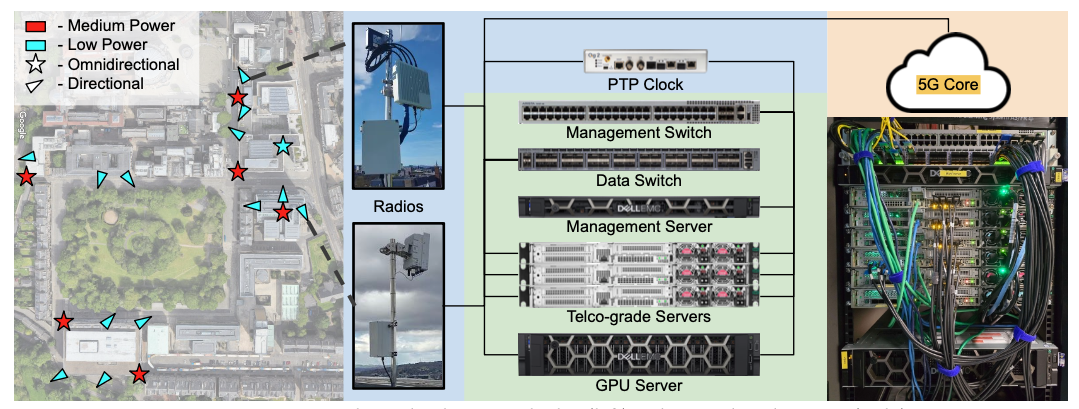 Campus5G: A Campus Scale Private 5G Open RAN TestbedAndrew E. Ferguson*, Ujjwal Pawar*, Tianxin Wang, and Mahesh K. MarinaSIGCOMM Computer Communication Review , July 2025
Mobile networks are embracing disaggregation, reflected by the industry trend towards Open RAN. Private 5G networks are viewed as particularly suitable contenders as early adopters of Open RAN, owing to their setting, high degree of control, and opportunity for innovation they present. Motivated by this, we have recently deployed Campus5G, the first of its kind campus-wide, O-RAN-compliant private 5G testbed across the central campus of the University of Edinburgh. We present in detail our process developing the testbed, from planning, to architecting, to deployment, and measuring the testbed performance. We then discuss the lessons learned from building the testbed, and highlight some research opportunities that emerged from our deployment experience.
@article{ferguson2025campus5g, title = {Campus5G: A Campus Scale Private 5G Open RAN Testbed}, author = {Ferguson, Andrew E. and Pawar, Ujjwal and Wang, Tianxin and Marina, Mahesh K.}, journal = {SIGCOMM Computer Communication Review}, volume = {55}, number = {3}, pages = {19--28}, year = {2025}, doi = {10.1145/3787927.3787930}, } - TMC
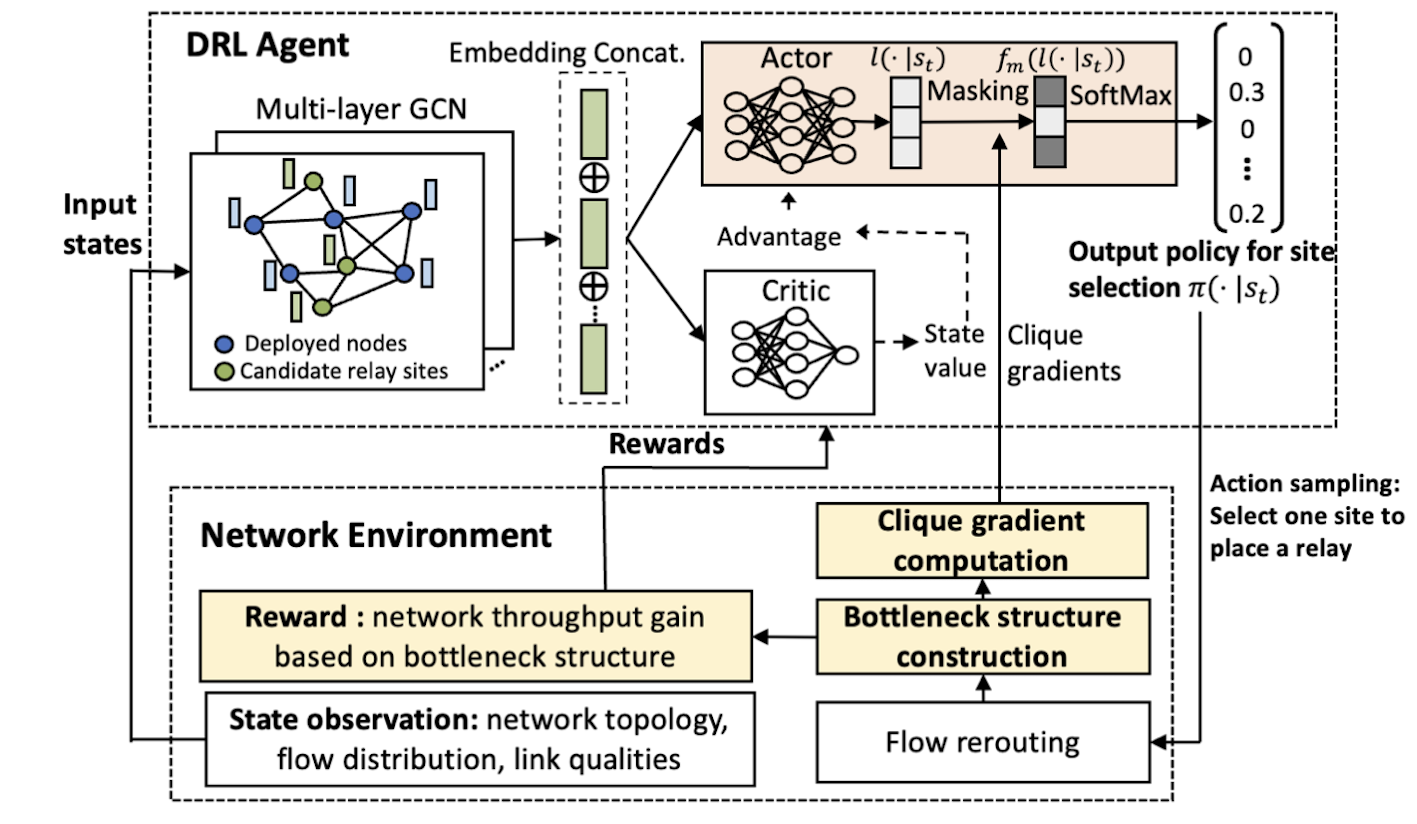 DeepRP: Bottleneck Theory Guided Relay Placement for 6G Mesh Backhaul AugmentationTianxin Wang, and Xudong WangIEEE Transactions on Mobile Computing , 2025
Backhaul mesh networks are critical for ensuring coverage and connectivity of high-frequency 6G networks. To maintain high throughput, its architecture needs to be augmented by adding relays. However, how to place relays at appropriate sites poses two challenges: there lacks a theory to capture the relationship between a certain change of network architecture and its throughput gain; and selecting the best sites for relays is a complicated combinatorial problem. To tackle the first challenge, this paper first establishes a clique-based bottleneck theory, through which a clique-based bottleneck structure of a given network architecture is constructed to determine the network throughput. Based on this bottleneck structure, clique gradients are then computed to quantify the impact of each clique on the overall network throughput. With the clique-based bottleneck theory, the second challenge is resolved by embedding clique gradients into a deep reinforcement learning scheme. Specifically, the DRL actions are masked such that only the relay sites that match the highest clique gradients are selected. This DRL-based relay placement (DeepRP) scheme is evaluated via extensive simulations, and performance results show that it can boost network throughput by more than 50%, which is 10.4–32.1% higher than those of baseline schemes.
@article{wang2025deeprp, title = {DeepRP: Bottleneck Theory Guided Relay Placement for 6G Mesh Backhaul Augmentation}, author = {Wang, Tianxin and Wang, Xudong}, journal = {IEEE Transactions on Mobile Computing}, volume = {24}, number = {3}, pages = {1744--1758}, year = {2025}, doi = {10.1109/TMC.2024.3487020}, } - INFOCOM
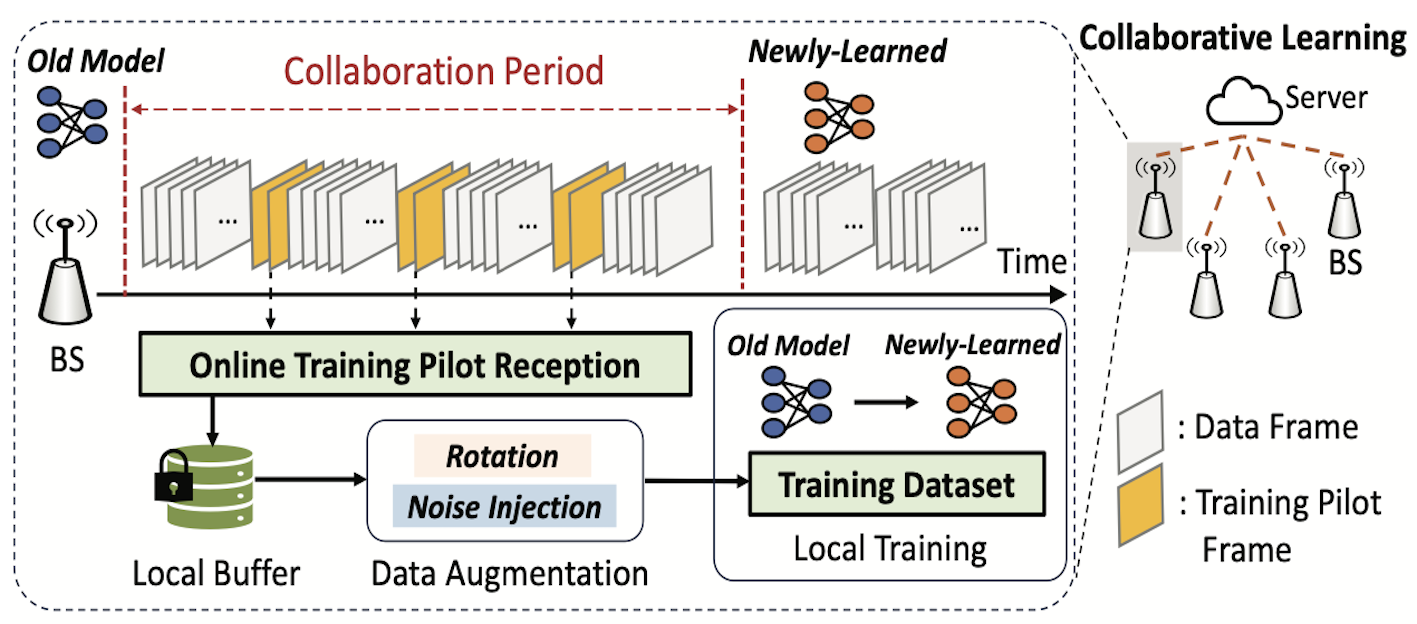 GraphRx: Graph-Based Collaborative Learning among Multiple Cells for Uplink Neural ReceiversTianxin Wang, Xudong Wang, and Geoffrey Ye LiIn IEEE Conference on Computer Communications (INFOCOM ’25) , 2025
A pre-trained neural receiver does not perform well in all channel environments, so online retraining is necessary. To acquire channel knowledge efficiently, collaborative learning among multiple neural receivers is indispensable. To this end, a graph-based collaborative learning scheme called GraphRx is developed to retrain uplink neural receivers collaboratively among base stations. First, considering a collaboration graph among base stations, GraphRx is formulated as a personalized federated learning problem, wherein the graph weights and neural receiver models are learned together so that generalization and personalization are jointly optimized. Second, the problem is solved through an alternating approach under the federated learning paradigm. Particularly, an approximate generalization bound is derived to enable graph optimization at the server without accessing local data on base stations. To reduce overhead of training pilots, data augmentation is employed. GraphRx is evaluated via extensive simulation. Results show that, given the same coded bit error rate, GraphRx achieves a SNR gain of 0.4–0.9 dB and 0.5–2.1 dB for the cases without and with inter-cell interference, respectively.
@inproceedings{wang2025graphrx, title = {GraphRx: Graph-Based Collaborative Learning among Multiple Cells for Uplink Neural Receivers}, author = {Wang, Tianxin and Wang, Xudong and Li, Geoffrey Ye}, booktitle = {IEEE Conference on Computer Communications (INFOCOM ’25)}, pages = {1--10}, year = {2025}, doi = {10.1109/INFOCOM55648.2025.11044726}, } - INFOCOM
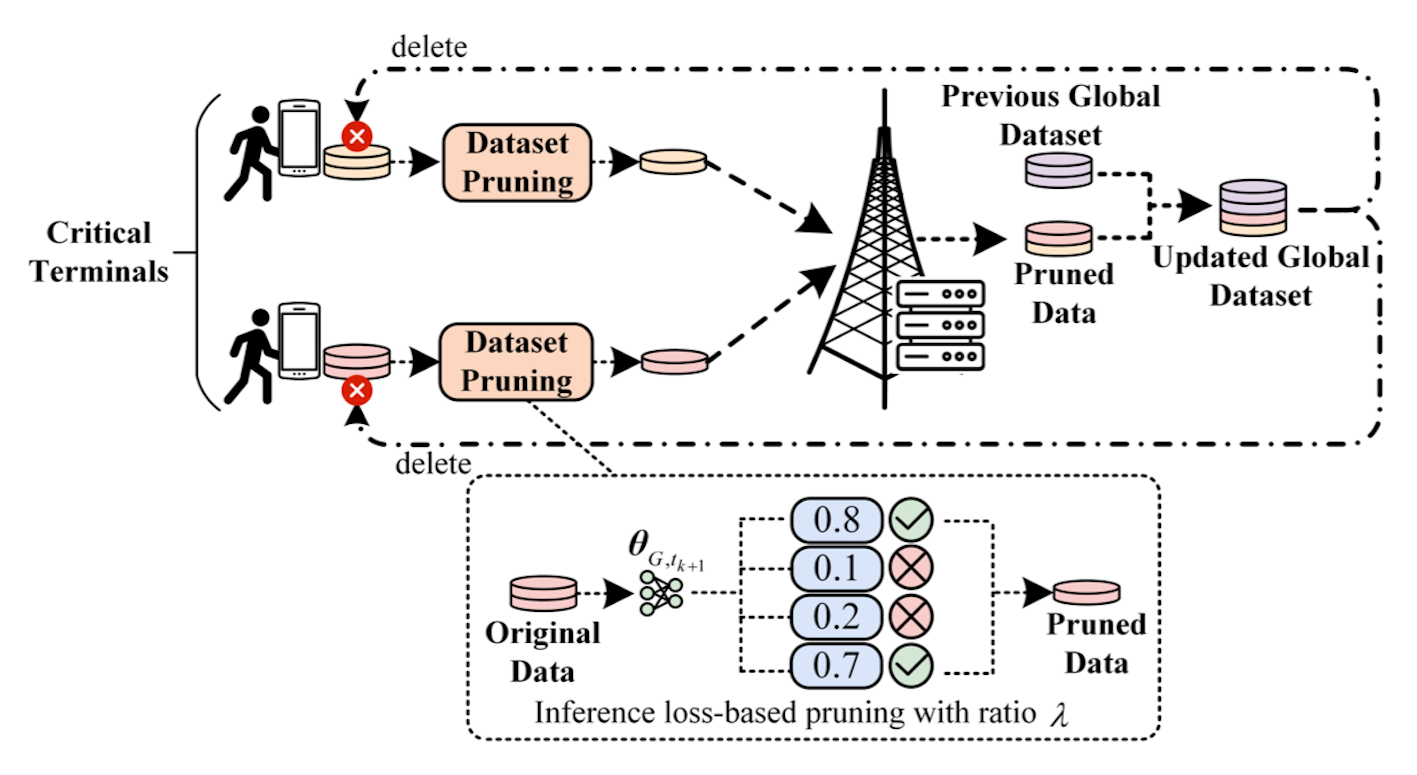 FedPDA: Collaborative Learning for Reducing Online-Adaptation Frequency of Neural ReceiversShuo Wang, Tianxin Wang, and Xudong WangIn IEEE Conference on Computer Communications (INFOCOM ’25) , 2025
Wireless neural receivers provide a promising alternative to conventional receivers. To perform well in different channel environments, online adaption is required. However, during this process, performance remains low. Thus, an approach called federated collaborative learning with pruned-data aggregation (FedPDA) is developed to reduce online-adaptation frequency. The basic idea is that, upon online adaptation, mobile terminals further update their neural receivers collaboratively via federated learning. To reduce memory consumption, neural receivers follow a main-side network architecture where only the side network needs retraining during collaborative learning. To avoid catastrophic forgetting during continual learning, local data on terminals are pruned, with only a small percent sent to the base station. With such data, the base station also trains a neural receiver before conducting model aggregation. FedPDA has a small memory footprint and no storage burden on terminals, no catastrophic forgetting issue, and low communication cost. Performance results show that FedPDA reduces online adaptation by more than 90% and memory footprint by 70%. It achieves comparable performance as centralized schemes, but reduces communication cost by 78%.
@inproceedings{wang2025fedpda, title = {FedPDA: Collaborative Learning for Reducing Online-Adaptation Frequency of Neural Receivers}, author = {Wang, Shuo and Wang, Tianxin and Wang, Xudong}, booktitle = {IEEE Conference on Computer Communications (INFOCOM ’25)}, pages = {1--10}, year = {2025}, doi = {10.1109/INFOCOM55648.2025.11044747}, } - MobiCom
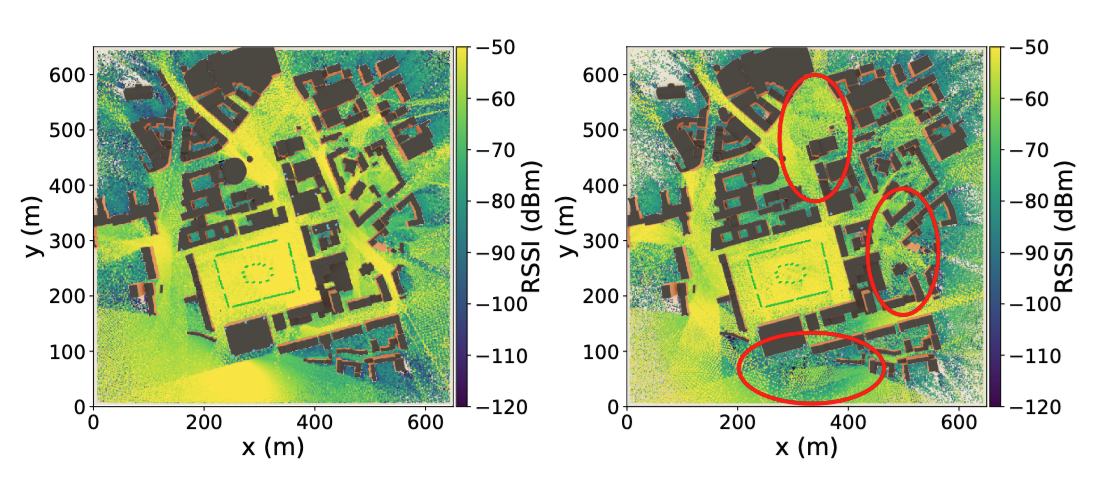 Demo: A Campus Scale Private 5G Open RAN TestbedAndrew Ferguson*, Ujjwal Pawar*, Tianxin Wang, and Mahesh K. MarinaIn 31st Annual International Conference on Mobile Computing and Networking (MobiCom ’25) , 2025MobiCom ’25 Best Demo Award
The next generation of mobile networks are embracing disaggregation, reflected by the industry trend towards Open RAN. Private 5G networks are viewed as particularly suitable contenders for adopting Open RAN, owing to their setting, high degree of control, and opportunity for innovation. Motivated by this, we have recently deployed the first of its kind campus-wide, O-RAN-compliant private 5G testbed across the central campus of the University of Edinburgh. We first present the rationale behind our testbed along with an overview of its make-up. Then, we outline our plan to showcase the coverage, flexibility, and the operational view of the testbed from both network side and user perspectives.
@inproceedings{ferguson2025campus5gdemo, title = {Demo: A Campus Scale Private 5G Open RAN Testbed}, author = {Ferguson, Andrew and Pawar, Ujjwal and Wang, Tianxin and Marina, Mahesh K.}, booktitle = {31st Annual International Conference on Mobile Computing and Networking (MobiCom ’25)}, pages = {1248--1250}, year = {2025}, doi = {10.1145/3680207.3765606}, } - MobiUK On Deploying a Campus Scale Private 5G Open RAN TestbedAndrew E. Ferguson*, Ujjwal Pawar*, Tianxin Wang, and Mahesh K. MarinaIn Seventh UK Mobile, Wearable and Ubiquitous Systems Research Symposium (MobiUK ’25) , 2025
Mobile networks have embraced disaggregation, driven by the need for cost-effective and flexible architectures that accelerate innovation and enable new services. These trends are most prominently evident in Open RAN. Motivated by private 5G networks as early adopters, we deployed a campus-wide, O-RAN-compliant private 5G testbed across more than 50 acres of the University of Edinburgh. The deployment uses twenty radios from two vendors, flexible RAN and RAN Intelligent Controller software, and an edge cloud for management, AI compute, storage, and data-driven applications. Planning and post-deployment measurements both show blanket campus coverage.
@inproceedings{ferguson2025deploying,
  title = {On Deploying a Campus Scale Private 5G Open RAN Testbed},
  author = {Ferguson, Andrew E. and Pawar, Ujjwal and Wang, Tianxin and Marina, Mahesh K.},
  booktitle = {Seventh UK Mobile, Wearable and Ubiquitous Systems Research Symposium (MobiUK ’25)},
  year = {2025},
}
2024
- WCL
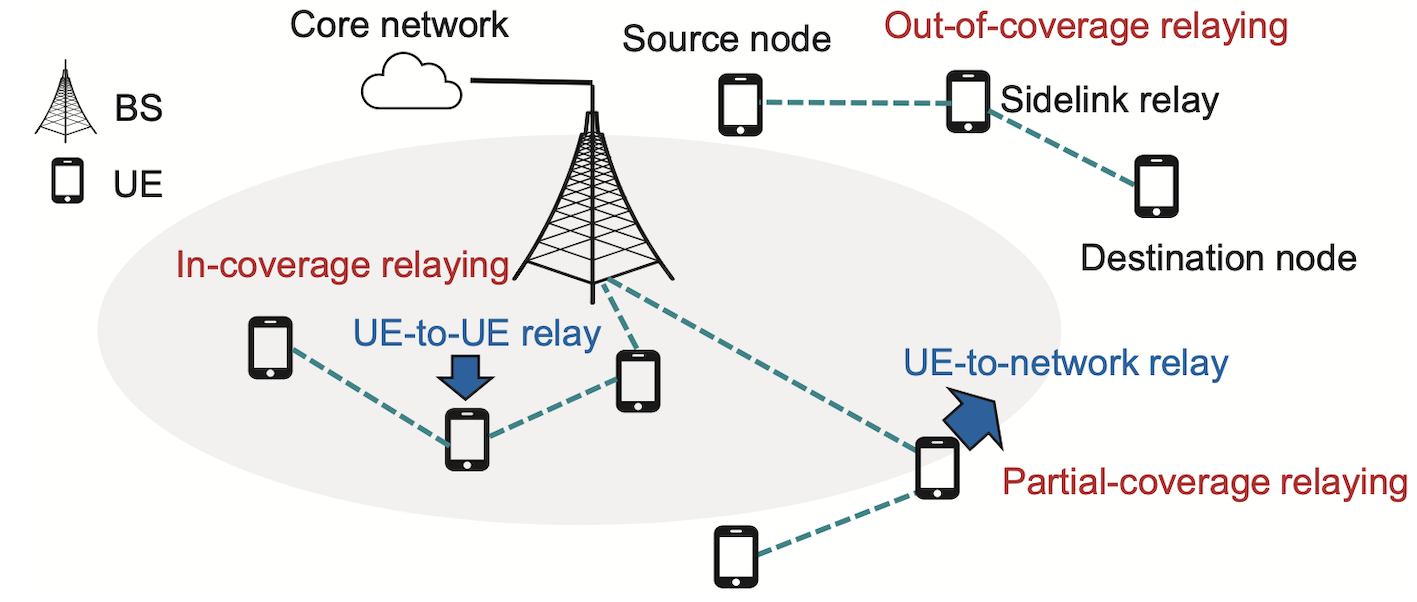 SideSeeker: Contention-Based Distributed Relay Finding for Sidelink Mesh NetworksTianxin Wang, Xudong Wang, and Yi-Bing LinIEEE Wireless Communications Letters , 2024
Sidelink relays are critical for enabling multi-hop peer-to-peer communications and ensuring connectivity of 6G sidelink mesh networks. To find proper sidelink relays without centralized coordination, a scheme of distributed relay discovery and selection named SideSeeker is designed with two key mechanisms. First, a two-dimensional contention scheme in time and frequency dimensions is designed based on short-term sensing, such that the collision of control signals is alleviated. Second, a mechanism of source-relay pair selection is developed, which prevents data congestion at a certain relay. With SideSeeker, the throughput over sidelinks outperforms those of baseline schemes by 19.4–36.9%.
@article{wang2024sideseeker, title = {SideSeeker: Contention-Based Distributed Relay Finding for Sidelink Mesh Networks}, author = {Wang, Tianxin and Wang, Xudong and Lin, Yi-Bing}, journal = {IEEE Wireless Communications Letters}, volume = {13}, number = {10}, pages = {2802--2806}, year = {2024}, doi = {10.1109/LWC.2024.3447057}, } - MLSP
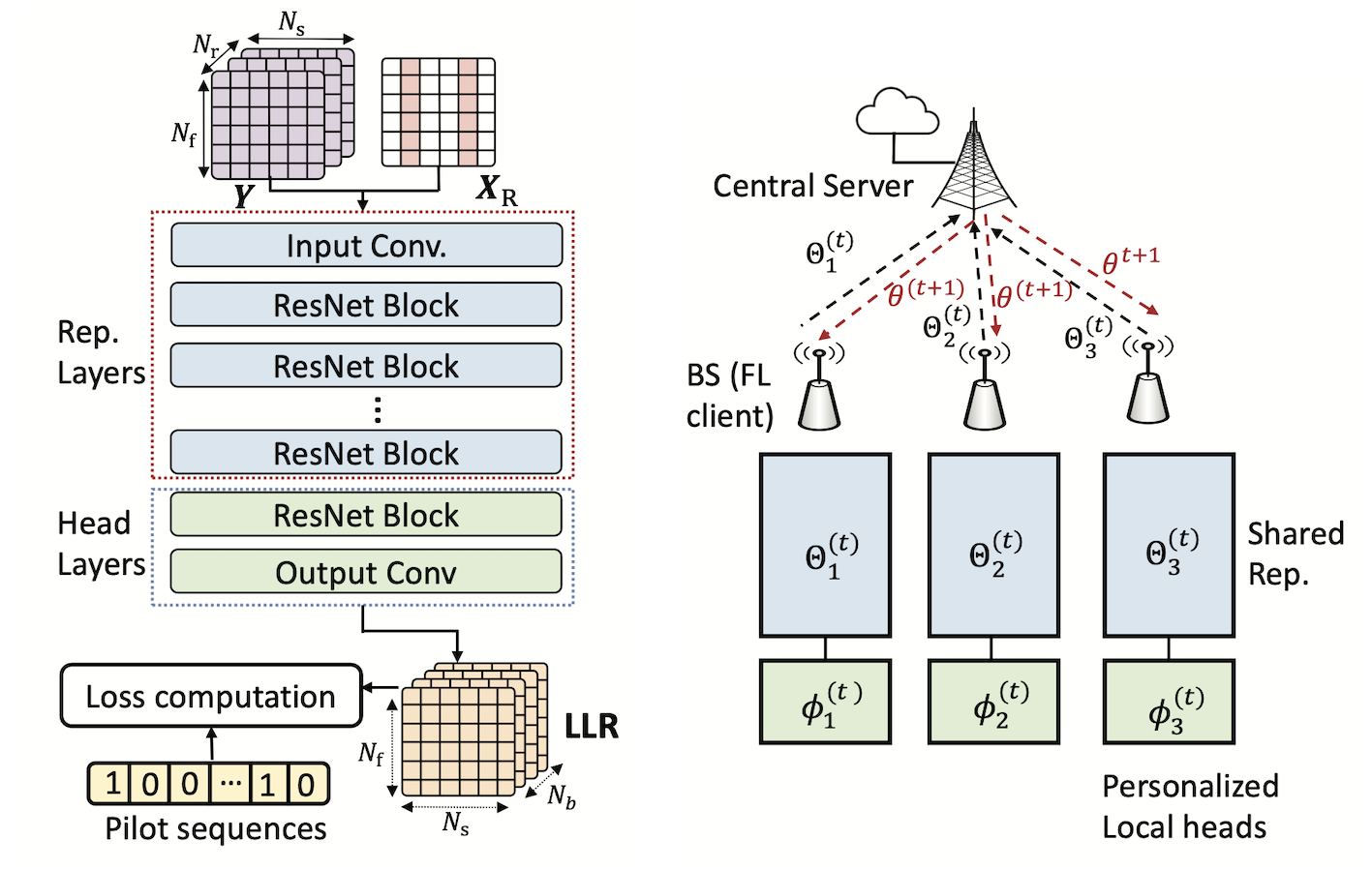 Collaborative Learning for Less Online Retraining of Neural ReceiversTianxin Wang, Shuo Wang, Xudong Wang, and Geoffrey Ye LiIn IEEE International Workshop on Machine Learning for Signal Processing (MLSP ’24) , 2024
Offline-trained neural receivers achieve significant performance gains. Yet, online retraining is required to sustain such gains in a new environment. Instead of retraining whenever a new channel environment arises, a multi-cell collaborative learning framework is designed to enable the neural receivers to generalize to unseen scenarios, thus preventing frequent retraining. This framework features two key designs: the personalized federated learning paradigm is exploited to strike a generalization-personalization balance, with each model sharing a global representation network and personalizing the local head network; and an online data filtering mechanism is designed to filter out low-impact data samples. According to simulations, the collaboratively-learned receivers outperform the traditional ones by over 3 dB and improve the generalization performance by 5.2 dB in the unseen scenarios.
@inproceedings{wang2024collaborative, title = {Collaborative Learning for Less Online Retraining of Neural Receivers}, author = {Wang, Tianxin and Wang, Shuo and Wang, Xudong and Li, Geoffrey Ye}, booktitle = {IEEE International Workshop on Machine Learning for Signal Processing (MLSP ’24)}, pages = {1--6}, year = {2024}, doi = {10.1109/MLSP58920.2024.10734801}, } - Patent
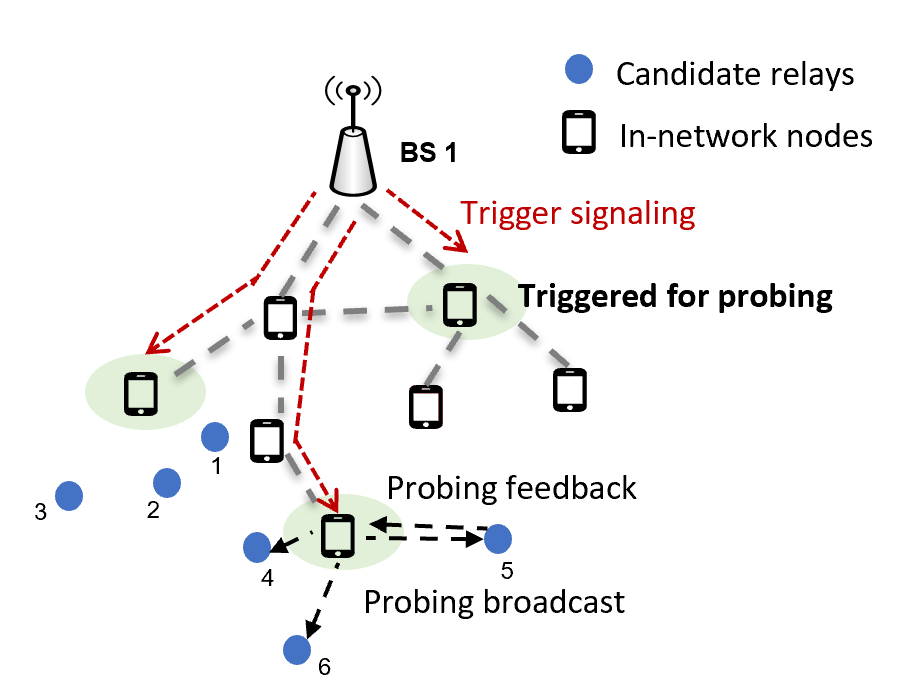 Method for Distributed Network Topology Reconfiguration Under Centralized CoordinationXudong Wang, Tianxin Wang, Aimin Tang, and Zhongfeng LiWO/2024/197884, CN121014224 , 2024International patent; publication date October 2024LINKPatent Misc
2023
- GLOBECOM
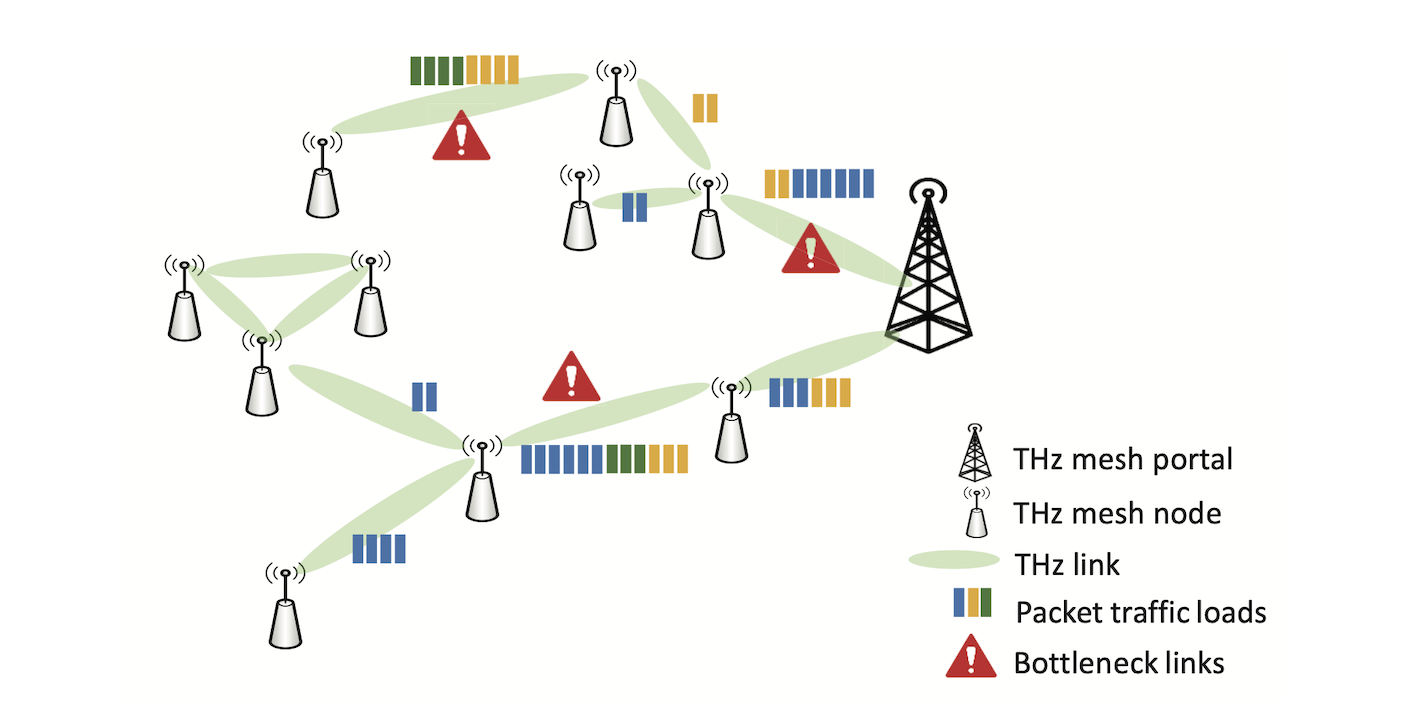 Boosting Capacity for 6G Terahertz Mesh Networks Based on Bottleneck StructuresTianxin Wang, and Xudong WangIn IEEE Global Communications Conference (GLOBECOM ’23) , 2023
Terahertz mesh networking is envisioned as a promising technology for 6G networks, with network capacity as one of the most critical performance metrics. To boost the network capacity of a terahertz mesh network, link resource planning is conducted, which poses two challenges. First, the relationship between link resources and network capacity must be captured quantitatively considering the peculiarities of terahertz mesh networking. Second, multi-dimensional resources including subarrays, power, and subbands need to be determined for link resource planning. To address the first challenge, a bottleneck structure is constructed by adapting the quantitative theory of bottleneck structures for terahertz mesh networks, such that the relationship between network capacity and a certain link resource planning result is determined. Furthermore, bottleneck gradients are computed based on the constructed bottleneck structure. Given the derived relationship and bottleneck gradients, a heuristic link resource planning algorithm is designed to allocate multi-dimensional resources, thus resolving the second challenge. Performance results show that the heuristic resource planning algorithm can boost the network capacity by 20.3–41.8% for various topologies.
@inproceedings{wang2023boosting,
  title = {Boosting Capacity for 6G Terahertz Mesh Networks Based on Bottleneck Structures},
  author = {Wang, Tianxin and Wang, Xudong},
  booktitle = {IEEE Global Communications Conference (GLOBECOM ’23)},
  pages = {4589--4594},
  year = {2023},
  doi = {10.1109/GLOBECOM54140.2023.10436964},
}
2022
- JSAC
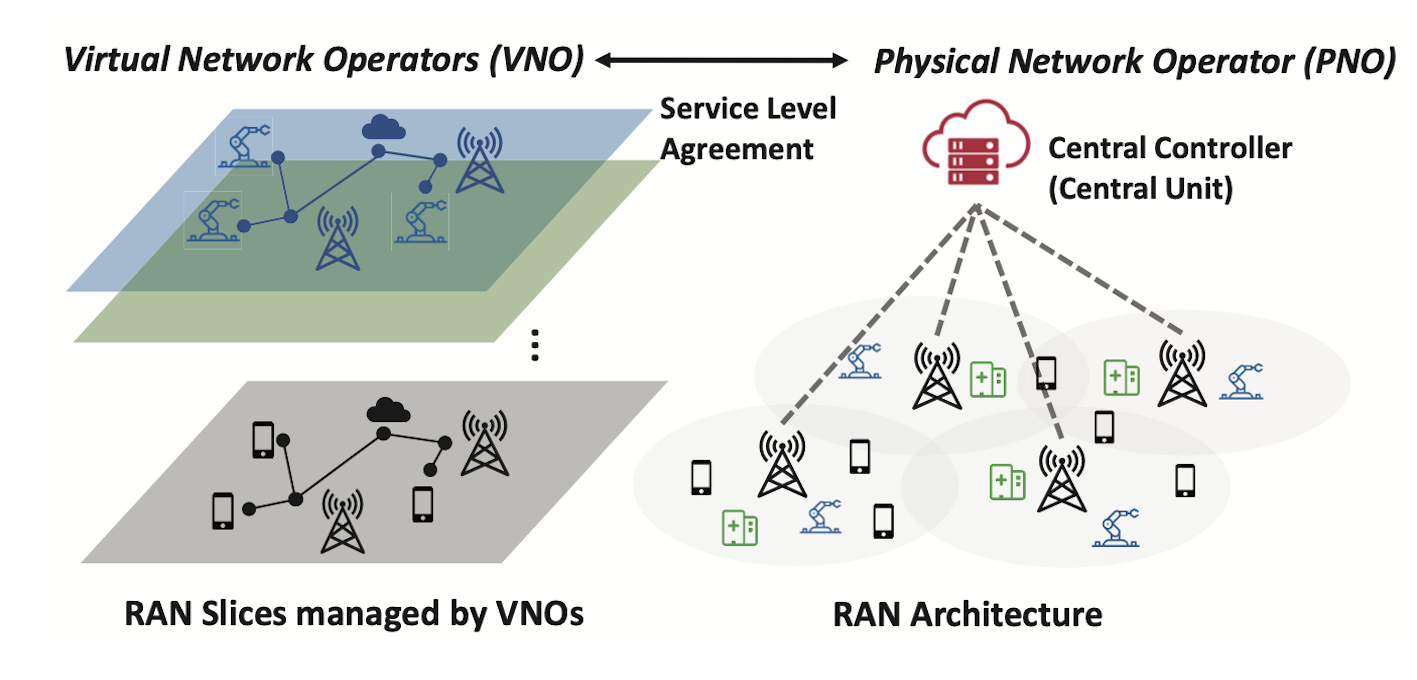 LinkSlice: Fine-Grained Network Slice Enforcement Based on Deep Reinforcement LearningTianxin Wang, Suhong Chen, Yifei Zhu, Aimin Tang, and Xudong WangIEEE Journal on Selected Areas in Communications , 2022
Considering network slicing in a cellular network, one of the most intriguing tasks is slice enforcement over air interfaces across multiple cells. The challenges lie in several aspects. First, resources allocated to different slices must achieve soft isolation at the link level. Second, users’ diverse QoS requirements must be satisfied even when communication links experience fading and interference. Third, long-term slicing policies must be conformed, no matter how unbalanced they are. To address these challenges, link-level slice enforcement is first formulated as a resource allocation problem that minimizes radio resource consumption while ensuring link-level soft slice isolation, guaranteeing users’ diverse QoS requirements, and conforming to slicing policies. Next, this problem is tackled via a deep reinforcement learning based approach, through which LinkSlice is designed as an iterative two-stage algorithm. The first stage determines transmission rates for each link based on DRL. It is embedded with a graph neural network to characterize link interference. Based on the transmission rates from the first stage, the second stage allocates resources to each slice. Performance results show that LinkSlice converges quickly to a near-optimal solution. It gracefully tackles the three challenges of link-level slice enforcement while further improving throughput by 18.5%.
@article{wang2022linkslice,
  title = {LinkSlice: Fine-Grained Network Slice Enforcement Based on Deep Reinforcement Learning},
  author = {Wang, Tianxin and Chen, Suhong and Zhu, Yifei and Tang, Aimin and Wang, Xudong},
  journal = {IEEE Journal on Selected Areas in Communications},
  volume = {40},
  number = {8},
  pages = {2378--2394},
  year = {2022},
  doi = {10.1109/JSAC.2022.3180776},
}